
Research
My research examines the politics of the energy transition. I study how emerging energy technologies create, reshape, and cross-cut the coalitions that drive climate and industrial policy in advanced democracies.
Dissertation: The Political Economy of Carbon Dioxide Removal Policies in Advanced Democracies
Advisor: Paasha Mahdavi
Dissertation
The Political Economy of Carbon Dioxide Removal Policies in Advanced Democracies
Meeting the IPCC targets will require removing billions of tons of CO2 from the atmosphere, yet current global capacity stands at roughly 50 Mt. Advanced democracies have adopted distinct policy regimes for carbon dioxide removal (CDR). My dissertation asks why the US, Canada, Norway, and Australia vary on three CDR policy dimensions: the policy means governments use to support CDR (tax credits vs. SOE vs. grants), the durability of that support across changing administrations, and which technologies fall within policy scope. Using within-case process tracing with Bayesian probability across four country cases, I argue that past industrial infrastructure (like EOR in the US), interest groups intermediatation, and state capacity in the crisis co-explain cross-national variation in CDR policy.
Committee: Paasha Mahdavi (Chair), Leah Stokes, Matto Mildenberger, Bruce Bimber
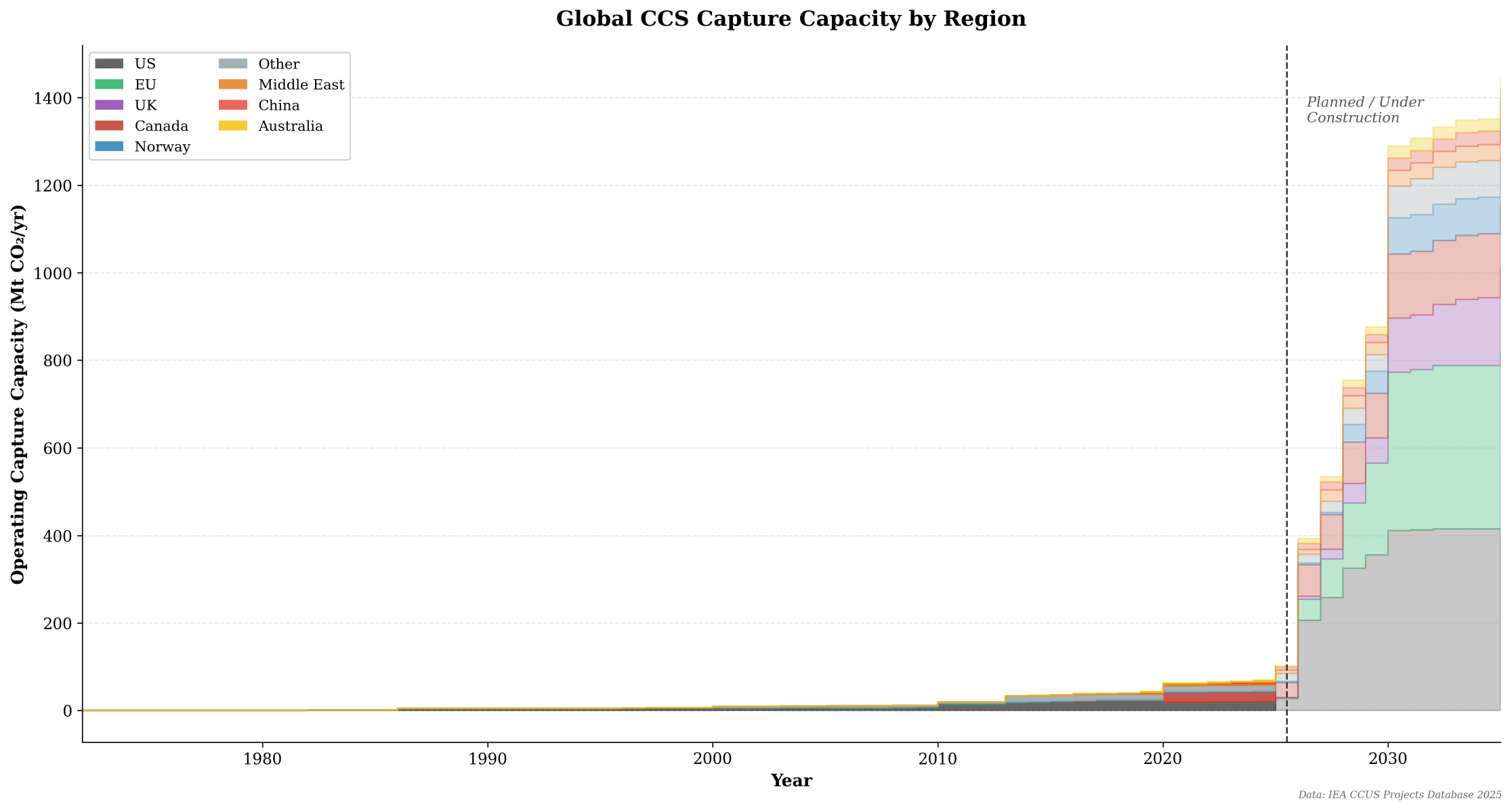
Global CCS capacity by region, 1996-2035 (historical and planned)
Peer-Reviewed Publications
Limited Impacts of Shareholder Pressure on Climate Strategy of Fossil Firms
Transitioning away from fossil fuels is in the best interest for long-term stakeholders of oil firms to mitigate risk from climate policy. Yet firms have an informational and positional advantage over strategies to mitigate climate-related risks, such that there is little incentive to decarbonize. Building on theories of firm behavior and the three faces of political power, we argue that investor pressure will be unlikely to change the climate strategy of fossil fuel firms. To measure climate strategy, we develop a novel technique using natural language processing (NLP) tools to parse annual filings of all publicly-listed oil firms in the US. Using a difference-in-differences design exploiting an exogenous shock to shareholder power from a Securities and Exchange Commission regulatory amendment, we find no effects of shareholder pressure on deep reforms to climate strategies and weak effects on incremental pro-climate behavior. Through a case study of ExxonMobil, we show that climate-motivated investors are unable to overcome internal stakeholder resistance, despite shareholder pressure through direct communication, filed resolutions, and media campaigns. Our findings illustrate that polluting firms remain resistant to financial pressure for decarbonization, suggesting an important role for policy.
The Role of Digitalization in the Global Energy Transition
This article examines the role of digital technologies in accelerating the global energy transition. We analyze how digitalization affects energy efficiency, renewable energy deployment, and grid management across OECD and developing countries. The findings suggest that digital tools can significantly reduce transaction costs in energy markets and improve the integration of variable renewable energy sources.
Youth Non-Profit and For-Profit Solutions toward Achieving Sustainable Development Goals in Russia: Practices, Challenges and Trends
This paper examines how youth-led organizations in Russia contribute to achieving the UN Sustainable Development Goals through both non-profit and for-profit solutions. We survey organizational practices, identify key challenges, and document emerging trends in youth-driven sustainability initiatives.
Working Papers
Electoral Returns from Climate Policy: The Effect of the Inflation Reduction Act's Manufacturing Investments
Policy feedback theory predicts concentrated, visible benefits can generate electoral rewards for the party that enacted them. But climate policy that centers costs often produces electoral backlash. Can climate policy centered on benefits generate positive feedback? The Inflation Reduction Act used manufacturing tax credits to build a domestic clean energy supply chain, in theory boosting Democratic vote share where factories were built. We test this with a panel of 435 congressional districts across five presidential elections (2008-2024) and an original dataset of 523 clean energy manufacturing facilities. Two-way fixed-effects estimators identify a gain of approximately 1.5 percentage points in 2024 Democratic presidential vote share in treated districts. Effects are positive and significant at every level of treatment intensity: linear specifications imply approximately 0.4 percentage points per additional facility, and larger dollar investments are associated with larger electoral gains. Climate policy centered on benefits can avoid backlash and provide electoral returns.
Manufactured Acceptance of CCS Permits: Evidence from the Class VI Permitting Process in the United States
Community engagement has become central to carbon capture and storage (CCS) governance, yet researchers know little about what concerns the public raises during permitting and whether these fall within regulatory authority. We analyze 320 public comments from five Class VI carbon storage projects to examine which issues commenters prioritize and whether EPA can formally address them. Using natural language processing, we classify concerns as falling within ('in-scope') or outside ('out-of-scope') EPA's regulatory authority. We find that both supporters and opponents raise out-of-scope concerns: supporters mention environmental justice and procedural transparency concerns almost half the time, while opponents focus disproportionately on permitting-related issues and transparency. The in-scope/out-of-scope boundary functions as a recognition filter determining which concerns influence permitting decisions, effectively manufacturing acceptance by misaligning regulatory authority and public concerns.
Data Centers and the Distributive Politics of AI Infrastructure
The United States is building data centers to power artificial intelligence at an unprecedented rate, yet we know little about which communities host them, and why. Existing research explains data centers siting through technical and economic factors – access to cheap electricity, land, and water. We argue that siting is also a distributive political outcome: data centers concentrate benefits on technology firms while imposing costs on host communities. U.S. federalism conditions this relationship and determines whose interests prevail. We link a new dataset of over 4,000 U.S. data centers to county-level measures of technical, demographic, socioeconomic, and political indicators, comparing counties with existing data center development to counties with planned or withdrawn projects. Data centers were historically built in dense, higher-income, more educated, and more Democratic counties, but newer and planned projects are in counties that are more rural, whiter, and more Republican. We find that counties where projects have been formally withdrawn due to community opposition have higher voter turnout, higher homeownership rates, lower unemployment, and an older, whiter population than counties where projects have proceeded. In a subsequent case study of data center expansion into West Virginia, we show that when a state stands to gain economically from significant capital investment, it can preempt local authority to approve or deny projects outright, overcoming even well-organized community opposition.
The Comparative Politics of Carbon Removal: Why CDR Policy Regimes Vary across Advanced Democracies
Despite shared geological storage capacity, fossil fuel industries, and stated climate commitments, advanced democracies have adopted strikingly different policy regimes for carbon dioxide removal (CDR). This paper asks: why do CDR policy regimes vary across countries in their instrument design, durability, and technological scope? The answer lies in the interaction among three factors: inherited industrial infrastructure, coalition structure and strategic state capacity, and institutional context. CDR sits at the unique intersection of innovation policy and climate policy, requiring both cost reduction incentives to build new technological systems and regulatory structures for legal oversight of long-term storage. Using structured focused comparison across the US, Canada, Norway, and Australia, I show that countries vary independently on these two dimensions, producing distinct CDR trajectories that existing theories of either environmental politics or innovation policy alone cannot explain.
Conference Presentations
- American Political Science Association (APSA) (2023, 2024, 2025)
- Environmental Politics and Governance (EPG) (2023, 2024, 2026)
- Western Political Science Association (WPSA) (2025)
- Atlanta Conference on Science and Innovation Policy (ATLC) (2025)
- Political Economy of Climate and the Environment (PECE), University of Pennsylvania (2024)
- Political Economy of Climate and the Environment (PECE), UCLA (2023)
- Environmental Politics Workshop, UC Santa Barbara (2023, 2024)
- Data Science Showcase, UC Santa Barbara (2024)