
About
I am a PhD candidate in Political Science at UC Santa Barbara, where I also serve as a teaching assistant. I am affiliated with the EGAPE Lab and the 2035 Initiative. My advisor is Paasha Mahdavi.
I am a comparativist in the fields of political economy and environmental politics who studies how governments and firms navigate the energy transition. Substantively, I research why countries vary in Carbon Dioxide Removal (CDR) policy regimes, how firms respond to shareholder pressure on climate strategy, and what predicts the innovation of clean technologies in the era of polarization. I am a methodological pluralist who uses causal inference, text analysis, and process tracing. In my time as a PhD student I developed text classification models for detecting and categorizing corporate climate disclosure in SEC filings, available on Hugging Face.
My academic journey started with a dual-degree program in Political Science at the Moscow School of Social and Economic Sciences and International Politics at the University of Manchester, UK. I also spent a year as an exchange student at West Virginia University (once a Mountaineer, always a Mountaineer!). Before UCSB, I worked as a Sustainability & Risks Consultant at KPMG, as a Deputy Director at SDSN Russia, and interned at Transparency International.
Research
Dissertation
The Political Economy of Carbon Dioxide Removal Policies in Advanced Democracies
Meeting the IPCC targets will require removing billions of tons of CO2 from the atmosphere, yet current global capacity stands at roughly 50 Mt. Advanced democracies have adopted distinct policy regimes for carbon dioxide removal (CDR). My dissertation asks why the US, Canada, Norway, and Australia vary on three CDR policy dimensions: the policy means governments use to support CDR (tax credits vs. SOE vs. grants), the durability of that support across changing administrations, and which technologies fall within policy scope. Using within-case process tracing with Bayesian probability across four country cases, I argue that past industrial infrastructure (like EOR in the US), interest groups intermediatation, and state capacity in the crisis co-explain cross-national variation in CDR policy.
Committee: Paasha Mahdavi (Chair), Leah Stokes, Matto Mildenberger, Bruce Bimber
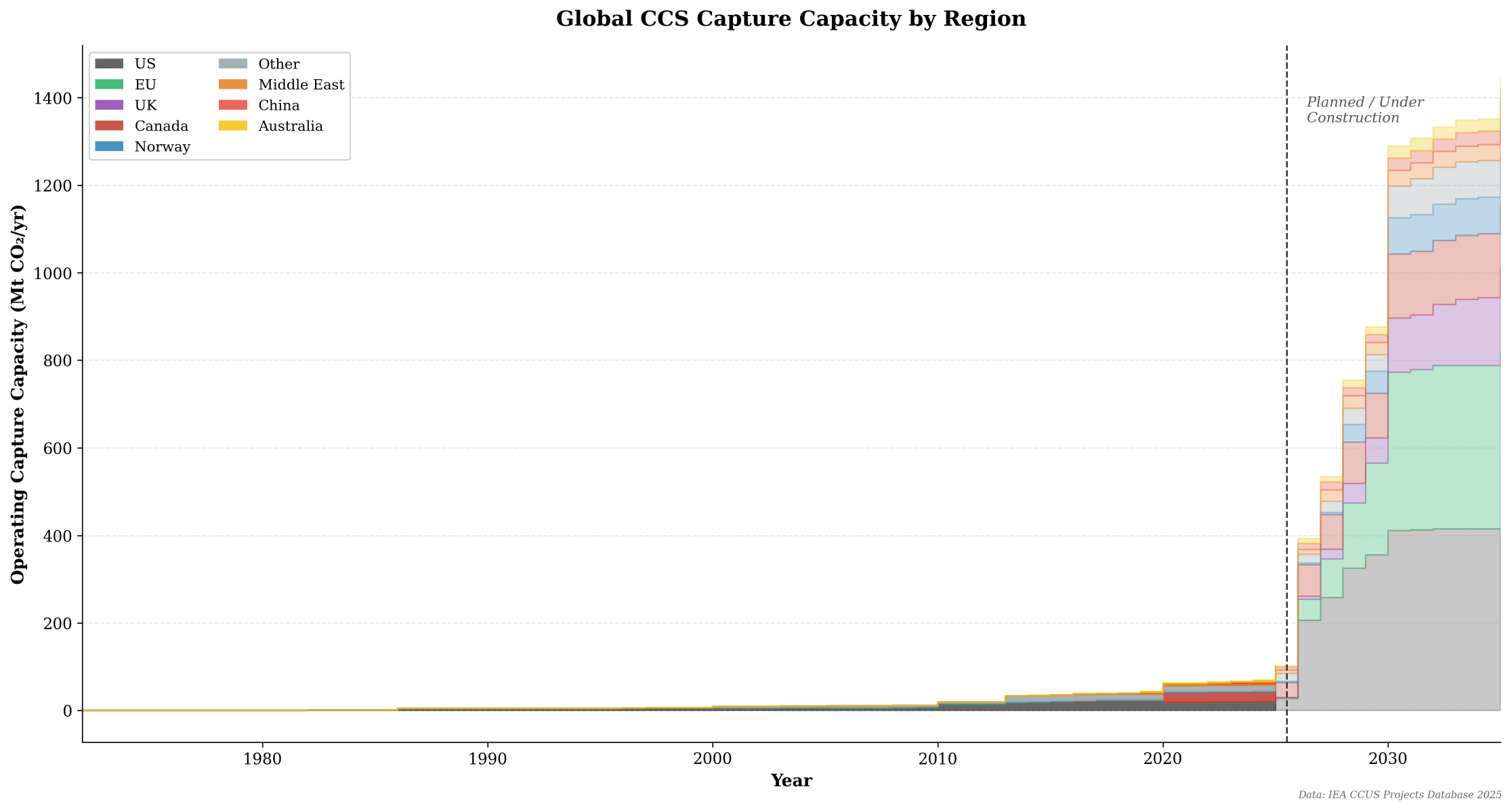
Global CCS capacity by region, 1996-2035 (historical and planned)
Peer-Reviewed Publications
Limited Impacts of Shareholder Pressure on Climate Strategy of Fossil Firms
ForthcomingAbstract
Can capital markets drive 'brown-to-green' transitions for fossil fuel incumbents? We argue that investor pressure alone is insufficient to overcome a hold-up problem in decarbonization: fossil firms can hold up future value held by their stakeholders by not mitigating climate-related risks. Using a novel NLP technique applied to 21 years of SEC 10-K filings (2000-2022) across all publicly listed U.S. oil and gas firms, we classify climate strategies based on SEC and TCFD standards. Exploiting the September 2020 SEC Rule 14a-8 amendment as an exogenous shock to shareholder power, we find that while the rule change led to more shareholder resolutions, its effects on firm climate strategies are limited. For almost all measures, there is no distinguishable difference in climate strategies between firms exposed to increased shareholder pressure and those not exposed. Policy will have to play an important role for brown-to-green transitions to occur.
The Role of Digitalization in the Global Energy Transition
PublishedAbstract
This article examines the role of digital technologies in accelerating the global energy transition. We analyze how digitalization affects energy efficiency, renewable energy deployment, and grid management across OECD and developing countries. The findings suggest that digital tools can significantly reduce transaction costs in energy markets and improve the integration of variable renewable energy sources.
Youth Non-Profit and For-Profit Solutions toward Achieving Sustainable Development Goals in Russia: Practices, Challenges and Trends
PublishedAbstract
This paper examines how youth-led organizations in Russia contribute to achieving the UN Sustainable Development Goals through both non-profit and for-profit solutions. We survey organizational practices, identify key challenges, and document emerging trends in youth-driven sustainability initiatives.
Carbon Capture & Climate Policy
When Regulators Innovate: Early (Un)Green Industrial Policy for Fossil Fuel Firms in the U.S.
Working PaperRQ: How did pre-existing EOR infrastructure and fossil fuel industry interests shape the design of U.S. carbon capture policy?
Presented at: Atlanta Conference on Science and Innovation Policy (ATLC), 2025
Abstract
This paper traces the political origins of Section 45Q, the U.S. carbon capture tax credit, to the Enhanced Oil Recovery (EOR) industry that has operated since 1972. I argue that the distinctive output-based, per-ton design of 45Q was shaped by pre-existing EOR infrastructure and its political constituencies, not by climate policy entrepreneurship. Using original data on 139 EOR projects, EPA greenhouse gas reporting, and CO2 source analysis, I show that the top 5 EOR operators account for over 70% of production and that 97% of CCUS lobbying expenditure (2005-2024) came from fossil fuel interests. The Section 43 input-based EOR credit (1990) served as a legislative predecessor even though 45Q adopted a fundamentally different output-based structure. This early industrial policy for fossil fuel firms created path dependencies that continue to shape U.S. carbon capture policy through the Inflation Reduction Act and beyond.
Figure
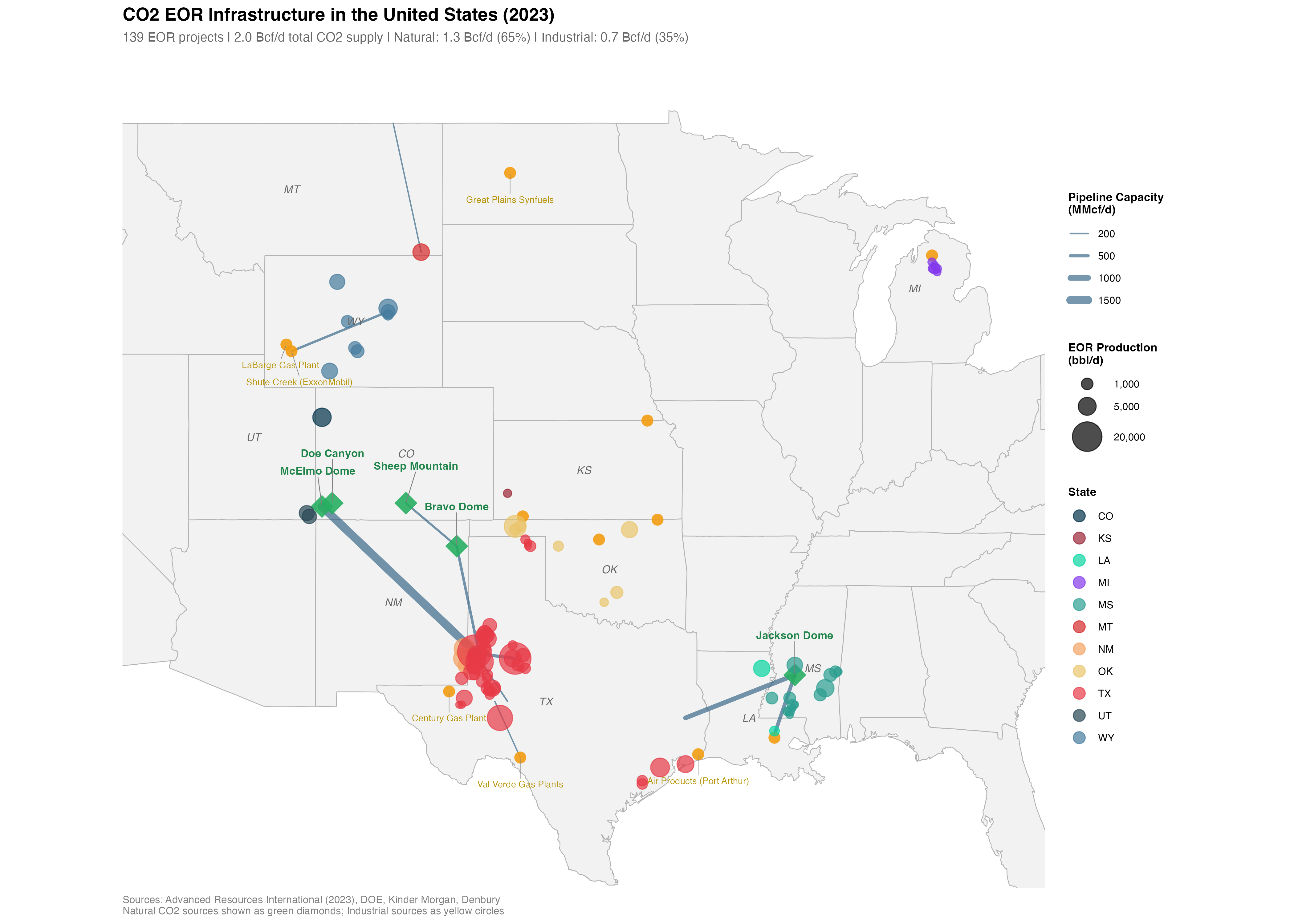
Geographic distribution of U.S. Enhanced Oil Recovery (EOR) projects and CO2 infrastructure
Manufactured Acceptance of CCS Permits: Evidence from the Class VI Permitting Process in the United States
Working PaperRQ: Does the Class VI permitting process adequately address community concerns, or does the regulatory scope create manufactured acceptance of CCS projects?
Abstract
Community engagement has become central to carbon capture and storage (CCS) governance, yet researchers know little about what concerns the public raises during permitting and whether these fall within regulatory authority. We analyze 320 public comments from five Class VI carbon storage projects to examine which issues commenters prioritize and whether EPA can formally address them. Using natural language processing, we classify concerns as falling within ('in-scope') or outside ('out-of-scope') EPA's regulatory authority. We find that both supporters and opponents raise out-of-scope concerns: supporters mention environmental justice and procedural transparency concerns almost half the time, while opponents focus disproportionately on permitting-related issues and transparency. The in-scope/out-of-scope boundary functions as a recognition filter determining which concerns influence permitting decisions, effectively manufacturing acceptance by misaligning regulatory authority and public concerns.
Figures (3)
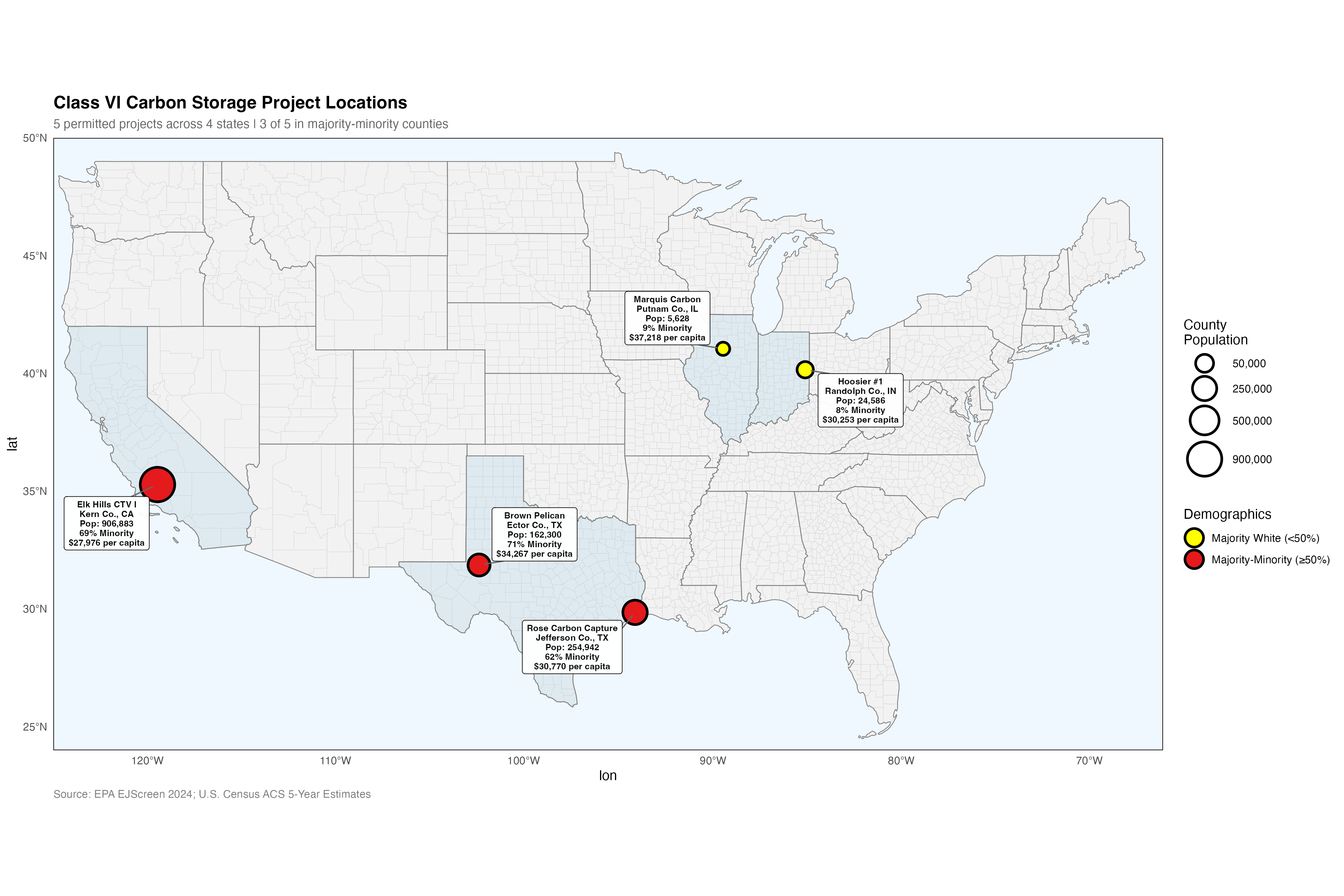
Class VI carbon storage project locations — 5 permitted projects across 4 states, 3 of 5 in majority-minority counties
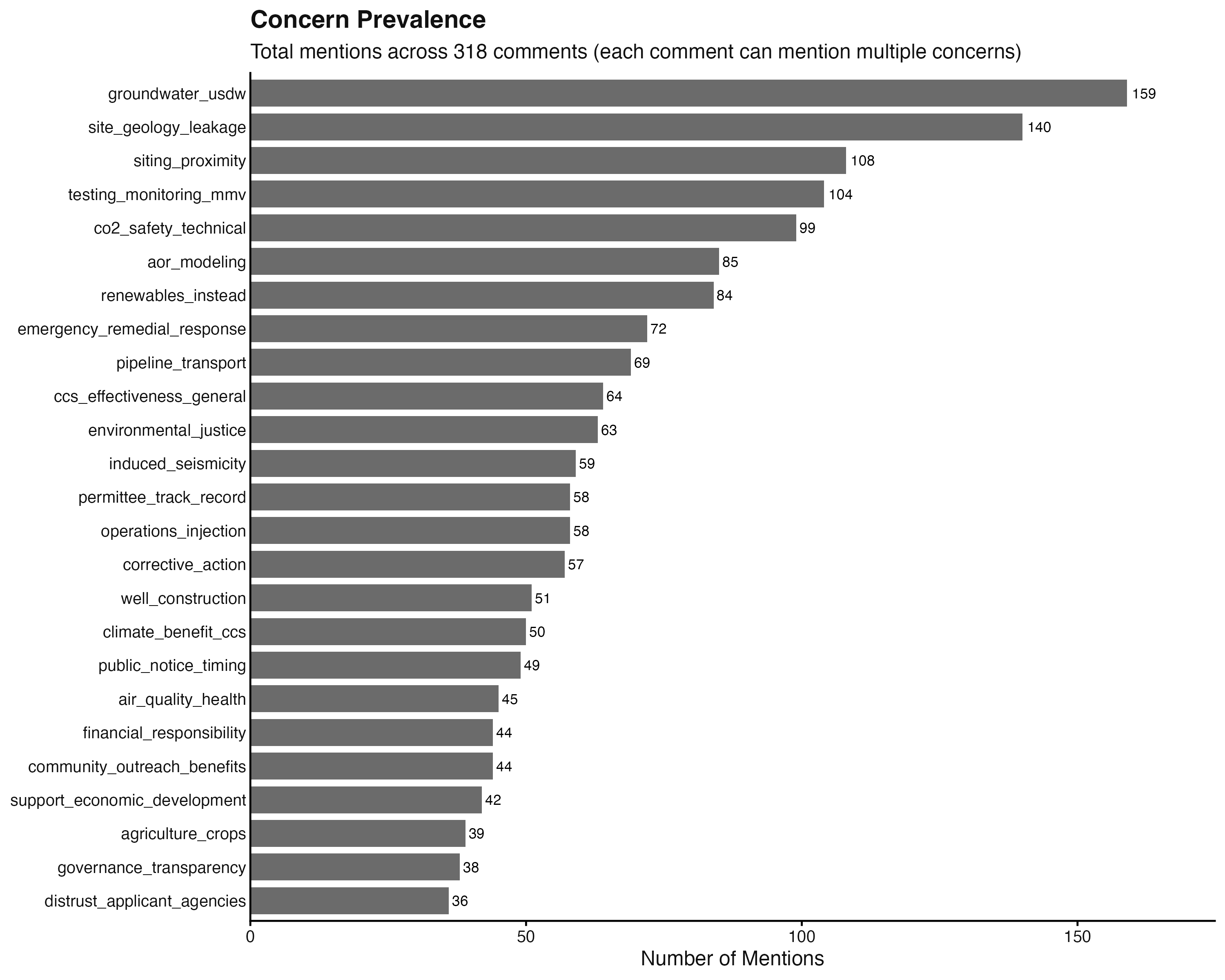
Concern prevalence across 318 public comments on Class VI permits (each comment can mention multiple concerns)
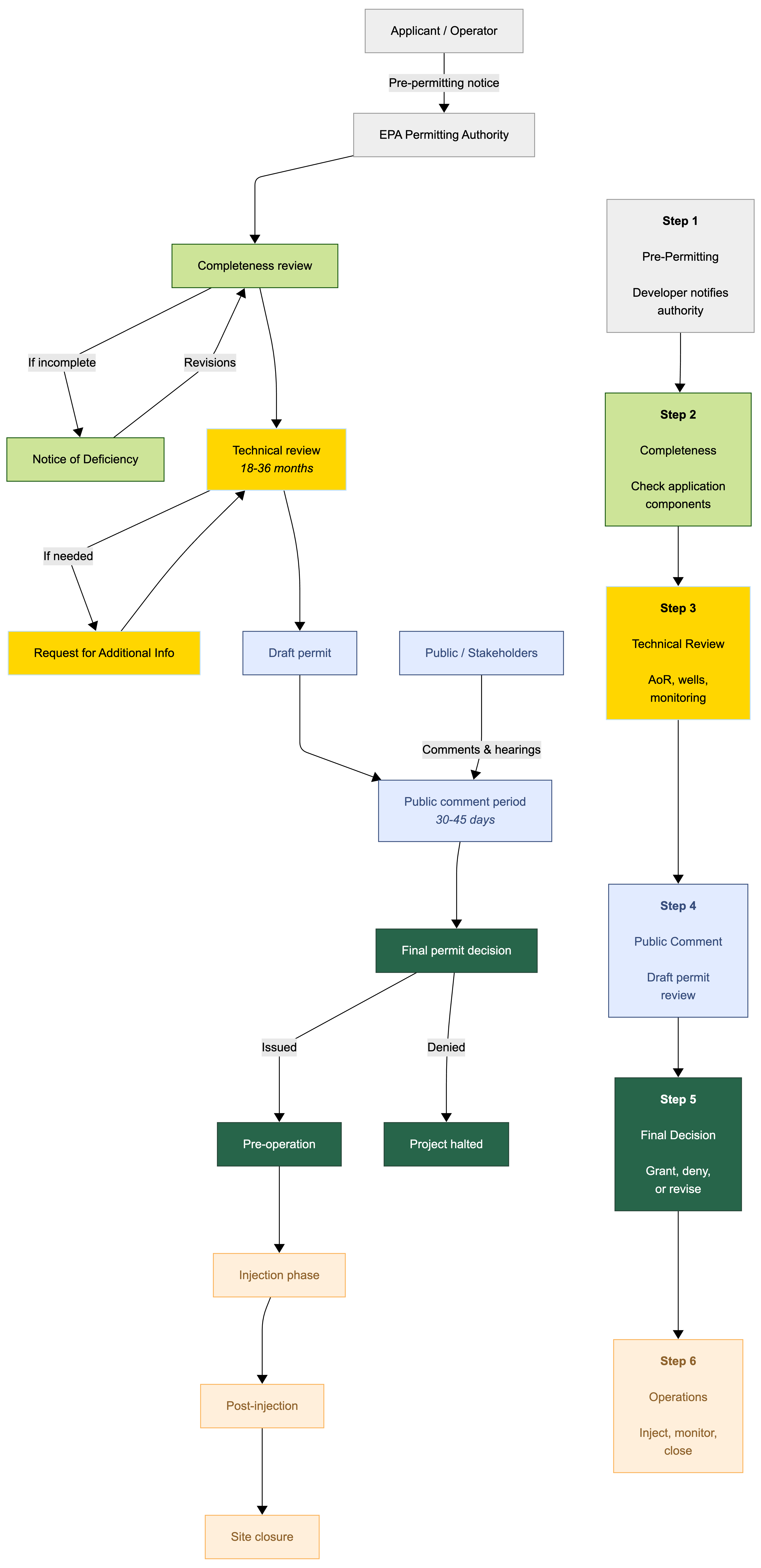
EPA Class VI carbon injection well permitting process
The Comparative Politics of Carbon Removal: Why CDR Policy Regimes Vary across Advanced Democracies
Working PaperRQ: Why do CDR policy regimes vary across comparable advanced democracies in their instrument design, durability, and technological scope?
Abstract
Despite shared geological storage capacity, fossil fuel industries, and stated climate commitments, advanced democracies have adopted strikingly different policy regimes for carbon dioxide removal (CDR). This paper asks: why do CDR policy regimes vary across countries in their instrument design, durability, and technological scope? The answer lies in the interaction among three factors: inherited industrial infrastructure, coalition structure and strategic state capacity, and institutional context. CDR sits at the unique intersection of innovation policy and climate policy, requiring both cost reduction incentives to build new technological systems and regulatory structures for legal oversight of long-term storage. Using structured focused comparison across the US, Canada, Norway, and Australia, I show that countries vary independently on these two dimensions, producing distinct CDR trajectories that existing theories of either environmental politics or innovation policy alone cannot explain.
Figure
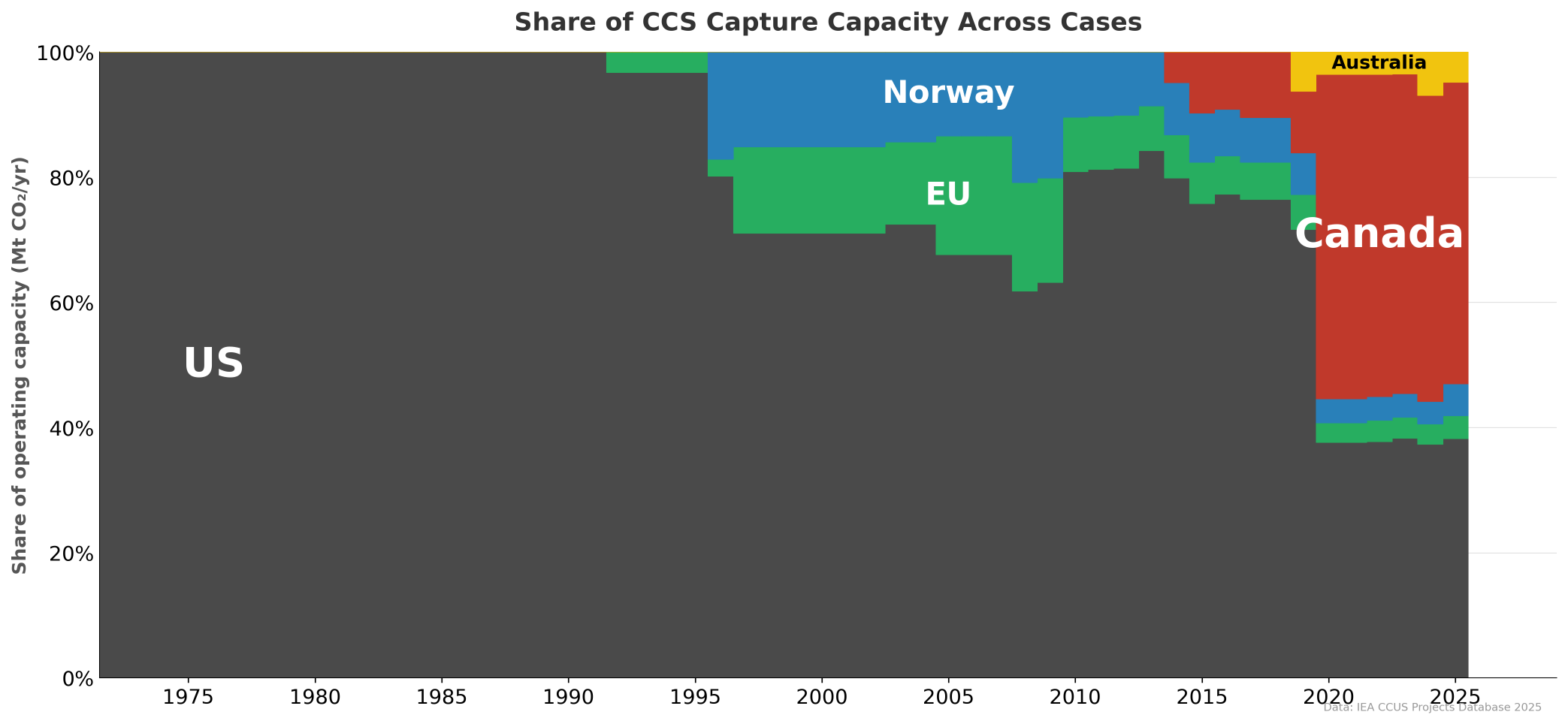
Share of global CCS projects by country case, 1996-2025
The Impact of 45Q on Carbon Capture Deployment in the United States
In ProgressRQ: What is the causal effect of the 45Q tax credit expansions on CCS project deployment across U.S. states?
Abstract
This paper estimates the causal impact of the Section 45Q carbon capture tax credit on CCS project deployment across U.S. states. Using staggered difference-in-differences methods and exploiting the 2018 FUTURE Act expansion and 2022 IRA enhancement as policy shocks, I examine whether and how much the per-ton credit incentive drove new project announcements, permit applications, and operational capacity. The analysis leverages the IEA CCUS Projects Database alongside state-level panel data on EOR infrastructure, Class VI permitting, and political variables.
Innovation & Technology Politics
Data Centers and the Distributive Politics of AI Infrastructure
In ProgressRQ: How do federalism and business power shape the siting of AI data center infrastructure, and what are the environmental justice implications?
Abstract
What are the environmental and energy impacts of data centers in the United States, and how do stakeholder incentives interact with political institutions to shape data center siting outcomes? In H1 2025 alone, investments in computing infrastructure accounted for approximately 92% of GDP growth, while the presidential administration positioned data centers as strategic assets and advanced NEPA categorical exclusions to expedite permitting. Yet bipartisan local pushback has blocked or delayed $64 billion in data center projects. Using a novel dataset linking every identifiable U.S. data center to county-level outage records, EPA environmental justice data, and socio-political variables, we show that counties with data centers have higher percentages of non-whites, more EPA air pollution facilities, and higher concentrations of criteria air pollutants. U.S. federalism shapes data center siting by conditioning business power: firms site where they face weak political resistance, either through state preemption of local opposition or absence of opposition due to low political awareness.
The Political Determinants of Upstream Energy and Climate Innovation
Working PaperRQ: How does gubernatorial partisan control and legislative composition affect state-level clean energy innovation?
Abstract
Why do some U.S. states consistently generate higher volumes of climate-related innovation while others lag? Using a county-level panel dataset (2000-2024) combining USPTO patent data (CPC Y02 classification), wind and solar deployment databases, gubernatorial election data, and state policy variables, I examine how partisan control affects clean energy patenting and renewable deployment. I find that Democratic governors promote clean energy innovation only when paired with a split (divided) legislature, not with unified Democratic control — increasing patents by approximately 20%. This split government effect exists only before political polarization intensified around 2010. The findings suggest that divided government creates policy credibility that encourages private investment in clean energy innovation, but rising polarization has eroded this mechanism.
Energy & Distributional Politics
Who Benefits? Disparities in the Impact of Changing Energy Prices in the U.S.
Working PaperRQ: How do changing energy prices differentially affect communities across income, racial, and geographic lines in the U.S.?
Presented at: Western Political Science Association (WPSA), 2025
Abstract
This paper examines the distributional consequences of changing energy prices across U.S. communities. We analyze how energy price shocks differentially affect communities based on income, race, and geographic location, finding that lower-income and minority communities bear disproportionate burdens from energy price volatility.
Awards & Fellowships
Models & Code
Climate NLP Models
Fine-tuned transformer models for analyzing climate-related corporate communication in SEC filings and regulatory documents. Used to classify firm climate strategies based on SEC and TCFD standards across 21 years of 10-K filings.
Related paper: Limited Impacts of Shareholder Pressure on Climate Strategy of Fossil Firms
CCS Public Comment Classifier
NLP model for classifying public comments on carbon storage permits as in-scope or out-of-scope of EPA regulatory authority. Trained on 320 comments from five Class VI carbon storage projects.
Related paper: Manufactured Acceptance of CCS Permits
Replication Data: Shareholder Pressure
Replication data and code for the analysis of shareholder pressure effects on fossil firm climate strategy.
Related paper: Limited Impacts of Shareholder Pressure on Climate Strategy of Fossil Firms