Investors Cannot Decarbonize Oil and Gas on Their Own
Transitioning away from fossil fuels is in the long-term interest of those who own oil firms. Yet firms hold an informational and positional advantage over how climate risk gets managed, and there is little incentive to decarbonize. External pressure has limited impacts on decarbonizing polluting firms. What decides how much pressure gets through is regulation.
Read the article in Business & Politics · One-page PDF
- 530
- U.S. oil and gas firms, 2000 to 2021
- 5 of 7
- measures of climate strategy show no effect
- 1.2
- highest climate strategy score any firm reaches, on a scale topping out at 2
- 139
- shareholder proposals excluded by the SEC in 2024, up from 76
What we find
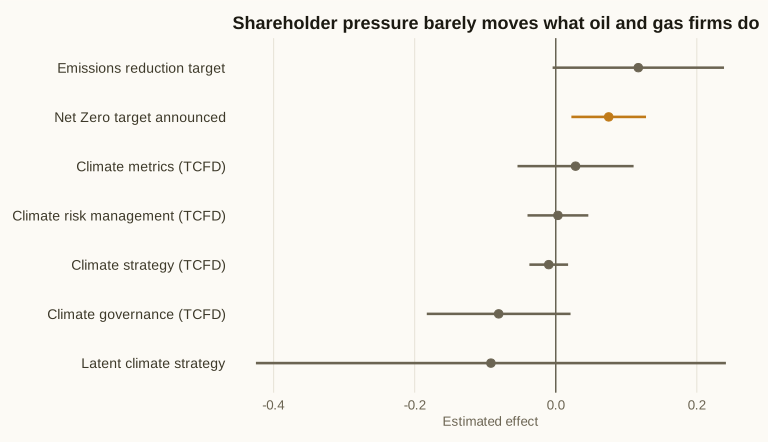
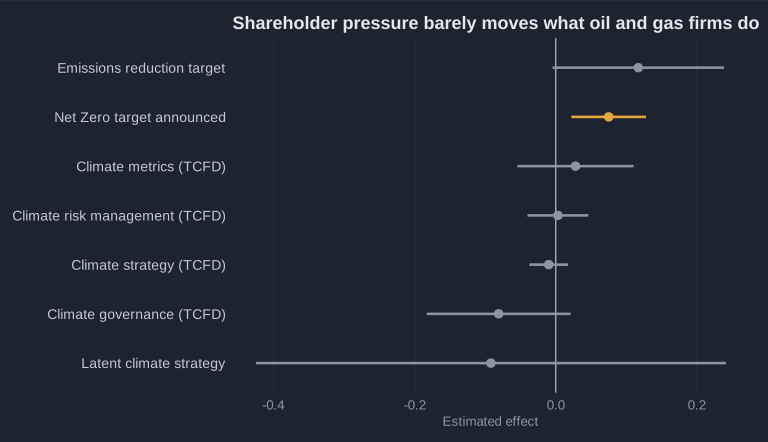
Shareholder pressure does not change climate strategy.
A 2020 SEC amendment changed which investors could file resolutions, which allows a difference-in-differences design across two decades of annual filings. For five of the seven measures we find clear null effects, and only one is distinguishable from zero at conventional levels.
The one positive result is an announcement, and it does not hold up.
Exposure corresponds to a seven percentage-point increase in a firm's willingness to declare a Net Zero target, but firm fixed effects drop it to five points and it is no longer significant. An announcement with no details or timelines is hedging, not a strategic shift.
More resolutions were proposed. No more of them were voted on.
The rule led to more resolutions proposed, and to no difference in the number successfully filed and voted on. Existing regulations and judicial levers grant firms considerable power to resist, and the SEC "no-action" letter is the central one.
After two decades, no firm exhibits high climate strategy.
On a latent measure scaled from -2 to +2, the maximum observed value in the sample is 1.2. At ExxonMobil, climate-motivated investors filed resolutions, campaigned in the media and seated three board members, and still could not overcome internal stakeholder resistance.
What this means for policy
The implications below follow from the paper's comparison of the U.S. with the E.U. and U.K., and from its conclusion that policy will have to play an important role for brown-to-green transitions to occur.
Do not treat investor pressure as a substitute for regulation.
Where climate regulation is minimal and disclosure is voluntary, firms face little regulatory cost for answering shareholder pressure with business as usual or with soft commitments to future action. Consequently there is no regulatory benefit for a deep strategic shift.
Set a mandatory disclosure floor.
Firms under the E.U. Corporate Sustainability Reporting Directive and the U.K. Sustainability Reporting Standards face a mandatory floor for disclosing climate risk. These differing frameworks likely explain the divergence between U.S. and European oil majors: institutional design mediates corporate power and sets the boundaries of permissible engagement.
Look again at the procedures that let firms exclude proposals.
The absence of no-action letters in the U.K. and E.U. removes a procedural barrier that U.S. firms use to exclude proposals before a vote, and exclusions rose to 139 in 2024 from 76 in 2023. Eligibility thresholds and exclusion procedures, not investor appetite, decide whether pressure reaches a ballot.
Pair engagement with levers that bite.
Shareholder engagement is necessary but not sufficient. Sustainability-linked loans or results-based financing may be more effective as carrots when coordinated with resolutions, and engagement that arrives on the heels of successful climate litigation may prove more potent.
Sources
- Lomov, Denis, and Paasha Mahdavi. Limited Impacts of Shareholder Pressure on Climate Strategy of Fossil Firms. Business & Politics, 2026. doi:10.1017/bap.2025.10021.
- U.S. Securities and Exchange Commission. Procedural Requirements and Resubmission Thresholds under Exchange Act Rule 14a-8. 2020.
- Ceres. Shareholder Resolutions Database. Accessed 2025.
- European Commission. Corporate Sustainability Reporting Directive (EU) 2022/2464. 2022.