Climate Policy Centered on Benefits Can Win Votes
Climate policy that centers costs often produces backlash. The Inflation Reduction Act centered benefits instead, through manufacturing tax credits that put factories in particular places. Districts that received one gained about 1.5 percentage points in 2024 Democratic presidential vote share, and no district shows backlash.
Read the working paper on SSRN · One-page PDF
- +1.5 pts
- gain in 2024 Democratic vote share in treated districts
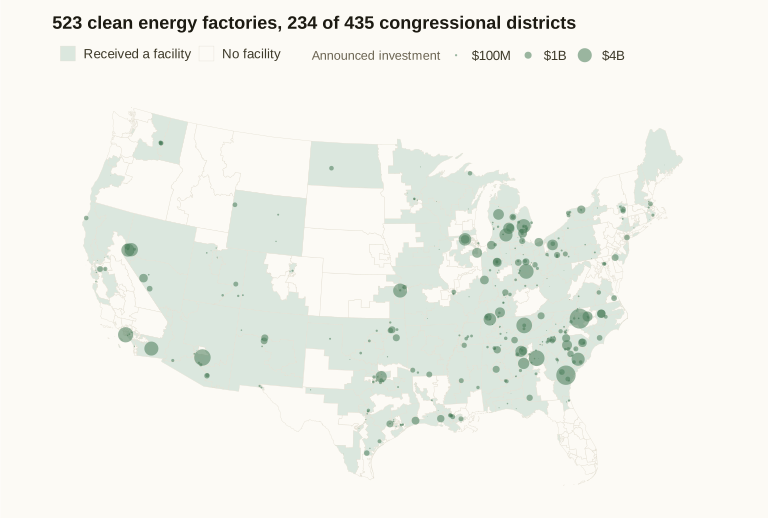
- 523
- clean energy manufacturing facilities
- 234 of 435
- congressional districts received at least one
- $185B
- in announced capital investment
What we find
Concentrated, visible benefits generate electoral rewards.
A panel of 435 congressional districts across five presidential elections is paired with an original dataset of 523 clean energy manufacturing facilities. Two-way fixed-effects estimators identify a gain of approximately 1.5 percentage points in treated districts, comparable to Trump's 1.48-point national popular-vote margin.
More investment, larger effect.
Effects are positive and significant at every level of treatment intensity, with approximately 0.4 percentage points per additional facility. Voters respond to the visible scale of investment in their communities.
The absence of backlash matters.
Predicted effects are positive across the entire range of treated districts, from roughly +2.5 points in the most Democratic to +0.6 in the most Republican. In contrast to the conventional wisdom, visible place-based investment does not mobilize Republican-leaning voters against the enacting party.
Tax credits moved. Grants did not.
Roughly $97 billion in IRA funding, 84 percent of the total, had been obligated by January 2025, yet only a handful of federally funded projects had broken ground three years after the infrastructure law was signed. Twice as much energy funding was disbursed in the first year of the 2009 Recovery Act as in the first three years of that law.
What this means for policy
Design around carrots, not sticks.
Cost-based instruments have repeatedly produced backlash, from the 2014 repeal of the Australian carbon tax to the 2018 gilets jaunes protests, and the IRA's benefits-based approach produced the opposite. The political economy of climate policy is not inherently a backlash dynamic; it depends on the instrument.
Move fast enough to reach voters before the next election.
Programmatic delays erode the mechanism through which benefits-centered policy converts dollars into durable political support. A policy that is never implemented cannot plausibly be expected to create policy feedback.
Use tax credits when the point is to get things built.
Tax credits flowed quickly to firms and into visible construction, while grant programs lagged. Tax credits move dollars and projects faster than grants, and getting dollars out the door is essential for policy feedback.
Expect delivered investment to make repeal harder.
Visible, place-based investment, executed rapidly enough to reach voters before the next election, can produce electoral returns large enough to constrain subsequent retrenchment. These results are not only available to Democrats: Republicans could benefit electorally from these investments if they act to defend them.
Sources
- Stokes, Leah, and Denis Lomov. Electoral Returns from Climate Policy: The Effect of the Inflation Reduction Act's Manufacturing Investments. Working paper, 2026. SSRN 7226779.
- Clean Economy Tracker. Atlas Public Policy and Utah State University. Accessed April 2026. Licensed ODC-BY.
- MIT Election Data and Science Lab. U.S. Presidential Returns, 2008 to 2024.
- U.S. Census Bureau. American Community Survey five-year estimates, 2024 congressional district boundaries.