Carbon Storage Permitting Conflicts with Environmental Justice
Communities are given an arena to participate through public comment periods. Yet regulators are not required to contend with a substantial share of the concerns communities bring forward. While communities may be formally included in the process, they remain substantively excluded from meaningful participation.
Read the paper and replication materials on OSF · One-page PDF
- 39%
- of concern mentions land outside EPA's regulatory authority
- 2x
- the odds of raising an out-of-scope concern in majority-minority counties
- 0 of 24
- draft permits translated into another language
- 0
- projects denied, against 143 applications under review
What we find
The scope boundary is set before anyone writes a comment.
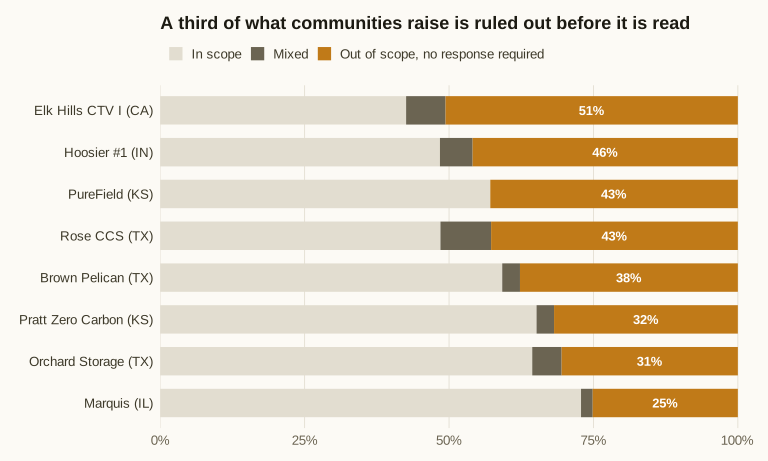
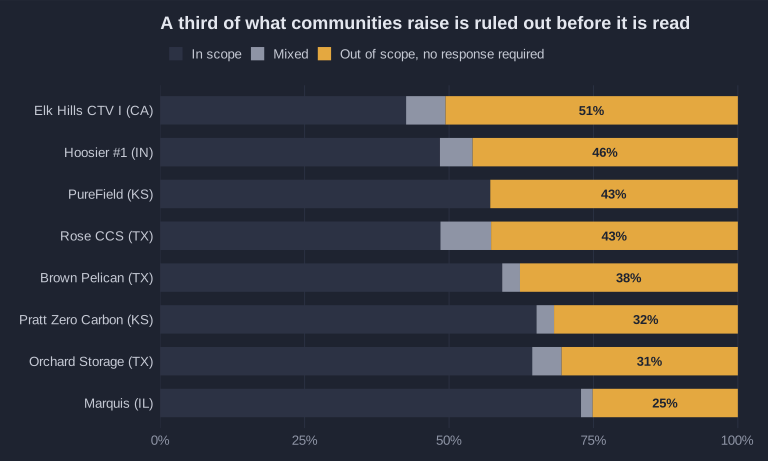
Across ten projects with completed comment periods, roughly 39 percent of concern mentions land outside the EPA's regulatory authority and receive no response. The boundary is predetermined, so these concerns can never be meaningfully engaged with inside the current governance process.
This exclusion falls hardest on individuals in majority-minority counties.
Individuals writing from majority-minority counties, which also encounter the heaviest environmental burden, have roughly twice the odds of raising an out-of-scope concern (odds ratio 2.111, CI 1.019 to 4.530). Recognition failure is the mechanism through which distributive inequities are reproduced inside the regulatory process.
The documents themselves are a barrier.
The draft permits average 15.1 on the Flesch-Kincaid Grade Level score, and none of the twenty-four were translated. Eight of the eleven host counties sit above the 50th percentile for residents without a high school diploma, who may lack the ability to comprehend a draft permit and write an in-scope comment.
Whether a concern is answered depends on which region reads it.
Whether a position-specific concern draws a substantive response depends on which region administers the permit: Region 6 treats environmental justice concerns as out of scope, Region 9 as in scope. For one project the EPA claimed no in-scope comments were submitted, where our analysis shows 57 percent were in scope.
What this means for policy
The implications below follow from the limits of the Class VI permitting framework documented above, and not from any position on carbon storage as a climate solution.
Make pre-application engagement mandatory.
Pre-application engagement is the only opening at which a community could shape what the agency goes on to examine, and it is discretionary. Participation is formally guaranteed at the point where it is substantively least consequential.
Apply one national scope standard across regions.
Identical concerns are in scope in one region and out of scope in another, a practice in tension with the EPA's own Community Engagement Guidelines. Binding national guidance would ensure that whether a concern is answered does not depend on which regional office received it.
Make the permits readable, and translate them.
A college-level permit in English only, in counties where a large share of residents speak Spanish at home, blocks the writing of a comment the agency will count. Plain-language summaries and translation belong in the requirements for a complete application.
Build a mechanism for cumulative burden now, while the sector is still small.
No federal mechanism requires acknowledgment of cumulative burdens. Corrective action addresses potential well failure and not repair of past harm, and firms, not regulators, supply what measures exist. Carbon storage is not yet widespread, which provides an opportunity to act before these choices are locked in.
Sources
- Lomov, Denis, and Kylie Gaines-Herrera. "Solamente Peligro y Destrucción": Carbon Storage Permitting and Environmental Justice in the United States. Under review, 2026.
- U.S. Environmental Protection Agency. Class VI Underground Injection Control Program, draft permits and response-to-comments documents. Accessed July 2026.
- U.S. Environmental Protection Agency. EJScreen environmental justice screening and mapping tool. 2024.
- U.S. Environmental Protection Agency. Public Participation Guide and Community Engagement Guidelines.
- Regulations.gov. Class VI permit dockets, including EPA-R09-OW-2023-0623.